
Predictions for Expected Supreme Court Decisions
Is This the Trump Court?

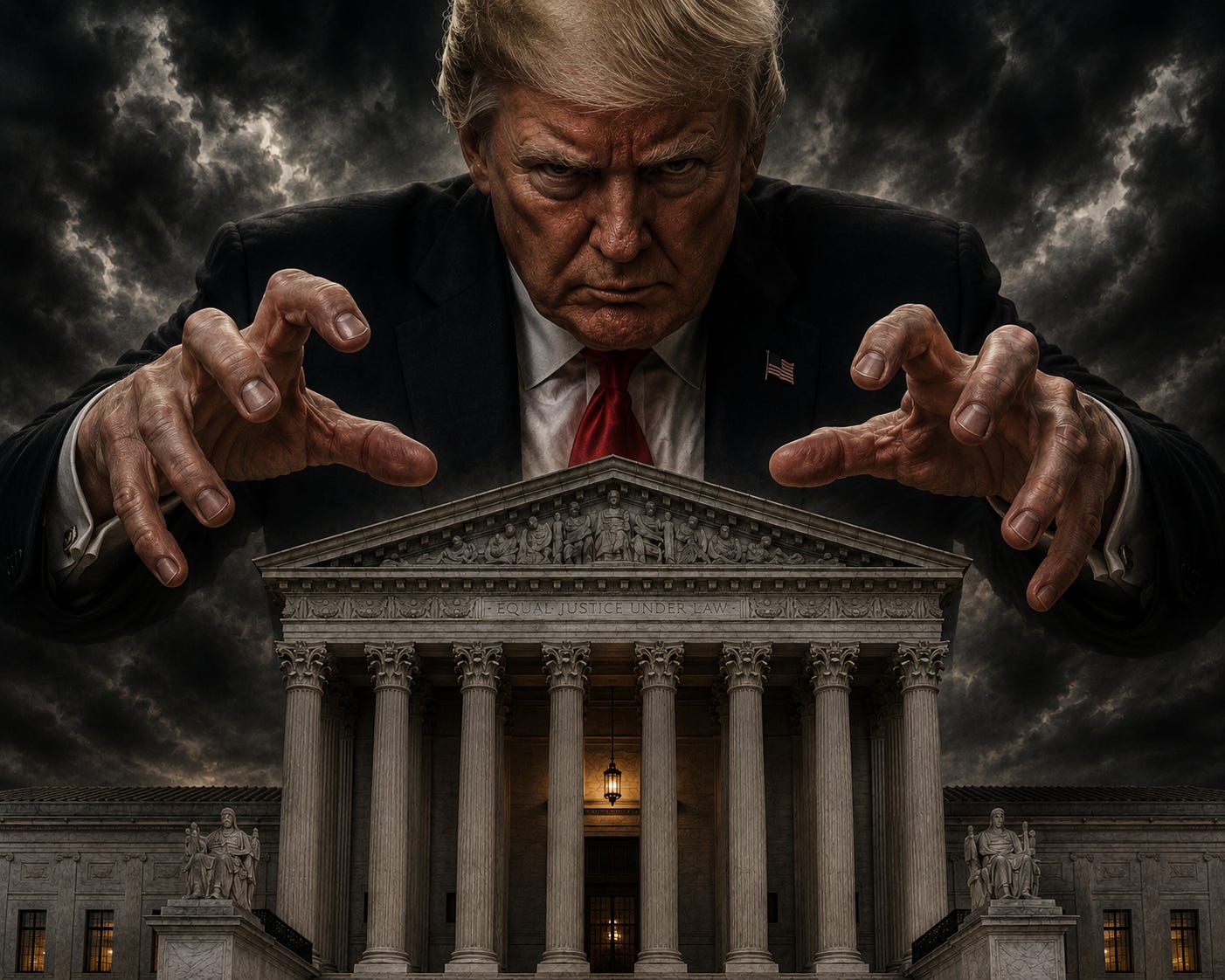
It’s getting to be that time of the year when the U.S. Supreme Court issues decisions on cases it heard earlier in the term. The June—or possibly July—2026 decisions may tell us less about any single doctrine than about the Court’s hierarchy of loyalties. My operating theory is that the Court is most likely to support Donald Trump when the case concerns his personal authority or presidential power directly. The more remote the question is from Trump himself, and the more it resembles ordinary policy, the more room there is for conservative justices to diverge. Thomas and Alito, however, remain the safest bets to stand by their man.
Here are my predictions on three of the cases.
Birthright Citizenship: Trump v. Barbara
On birthright citizenship, I predict the Court rules against Trump, perhaps 7–2. The case challenges Trump’s executive order seeking to deny automatic citizenship to some children born in the United States based on their parents’ immigration status—principally attacking children born to undocumented immigrants. The question is whether that order violates the Citizenship Clause of the Fourteenth Amendment and the federal statute codifying birthright citizenship.
At oral argument in April, Chief Justice Roberts was openly skeptical, describing the administration’s examples—children of ambassadors, children of enemies during hostile invasion, and children on warships—as “very quirky,” and questioning how the government could get from those examples to denying citizenship to an entire class of undocumented immigrants. Justice Kagan pressed the administration’s reading of Wong Kim Ark, the long-settled 1898 precedent establishing birthright citizenship, noting it rested on a clear common law tradition with only discrete exceptions. Justice Jackson added that the administration faced significant “hurdles to clear” in arguing the framers of the Fourteenth Amendment had not imported established common law rules into the Citizenship Clause.
My guess is that seven justices will find the executive order contrary to statute and the plain meaning of the Fourteenth Amendment. But only three justices—Kagan, Sotomayor and Jackson—will say clearly that any rollback of birthright citizenship is unconstitutional. Four may say Congress has some room to legislate in this area, but that the president cannot redefine citizenship by executive order.
That would resemble the tariffs pattern: Trump loses, but the Court avoids foreclosing future institutional action.
Executive Power: Trump v. Slaughter and the Viability of Independent Agencies
In Trump v. Slaughter, argued in December 2025, I predict a 5–4 ruling for Trump. The case asks whether statutory protections limiting the president’s ability to remove FTC commissioners violate separation of powers, and whether the longtime precedent in this area, Humphrey’s Executor, should be overruled.
The majority will likely hold that executive power is vested in the president, and that Congress cannot insulate executive officers from presidential removal. But I doubt the Court will formally declare independent agencies unconstitutional. Roberts and perhaps Barrett or Kavanaugh may prefer to move one large step at a time.
Thomas, Alito, and Gorsuch, however, may write separately to say explicitly what the majority leaves implicit—that independent agencies are constitutionally suspect because they exercise executive power outside direct presidential control. In dissent, Kagan is likely to argue, as she did at oral argument, that the Court should not blind itself to the real-world consequences of expanding presidential removal power at the very moment those powers are being tested. That has not seemed to influence justices who gave Donald Trump criminal immunity, with seemingly few limitations.
Voting Rights: Watson v. Republican National Committee
In Watson v. RNC, argued in March of 2026, I predict a majority ruling against Mississippi’s mail-ballot grace period, with Roberts or perhaps Kavanaugh joining the three liberals. The case asks whether federal Election Day statutes preempt state laws allowing mail ballots postmarked by Election Day to be counted if received shortly afterward. Thirty states presently allow post-Election Day grace periods for at least some voters (like military and overseas personnel), and there are 14 states plus Washington, D.C. that allow it for all mail-in voters.
At oral argument, Paul Clement argued for the challengers that when Congress established Election Day in the 19th century, the casting and receipt of ballots were so intertwined that no one would have conceived of separating them. Gorsuch pressed the state on whether voters could effectively revoke their choices after Election Day if a candidate were revealed to have been colluding with a foreign power—suggesting he views post-Election Day receipt as keeping the election itself open. Kavanaugh asked whether a June ruling could be implemented in time for the 2026 elections, a practical concern that cuts both ways.
The conservative majority will likely say federal law requires a single Election Day and that ballots received afterward cannot be counted in federal elections. Roberts could dissent because of federalism, reliance interests, and practical disruption to election administration or simply to show he’s fair and balanced. On other recent decisions, notably Callais, the majority has little regard for disruption when Democrats and minorities bear the brunt, so that’s unlikely to be an obstacle.
The liberals have a strong structural argument: Congress is currently considering legislation that would explicitly prohibit counting ballots received after Election Day. As Justices Kagan and Jackson noted at argument, the very fact that Congress believes new legislation is necessary suggests it understands current federal law to permit what Mississippi is doing. That argument may not carry the day, but it will make the majority work for its holding.
Predictions are Precarious
Predictions about Supreme Court decisions are inherently uncertain—oral argument tea leaves can mislead, and justices sometimes surprise. But the pattern across these three cases fits the theory I started with: the Court is most likely to break from Trump where the question is about policy rather than power, and most likely to stand with him where executive authority is directly at stake. If I’m right, birthright citizenship will be a loss for the Trump agenda (for now, at least), independent agencies will take another serious hit, and mail-in ballots received after Election Day will no longer count in federal elections. We’ll know soon enough.
You offer a bleak, but unfortunately realistic, prediction of upcoming SCT decisions; However, i wholeheartedly agree with your analysis rationale; I personally need your dose of realism. I keep wondering when, if indeed at all, this trend towards the perceived anarchy-as-reality gloom and doom can be reversed.