
Alfie and Me: Things I Worry About, but Not Too Much
What Happens If I Die and Alfie Needs Lunch?

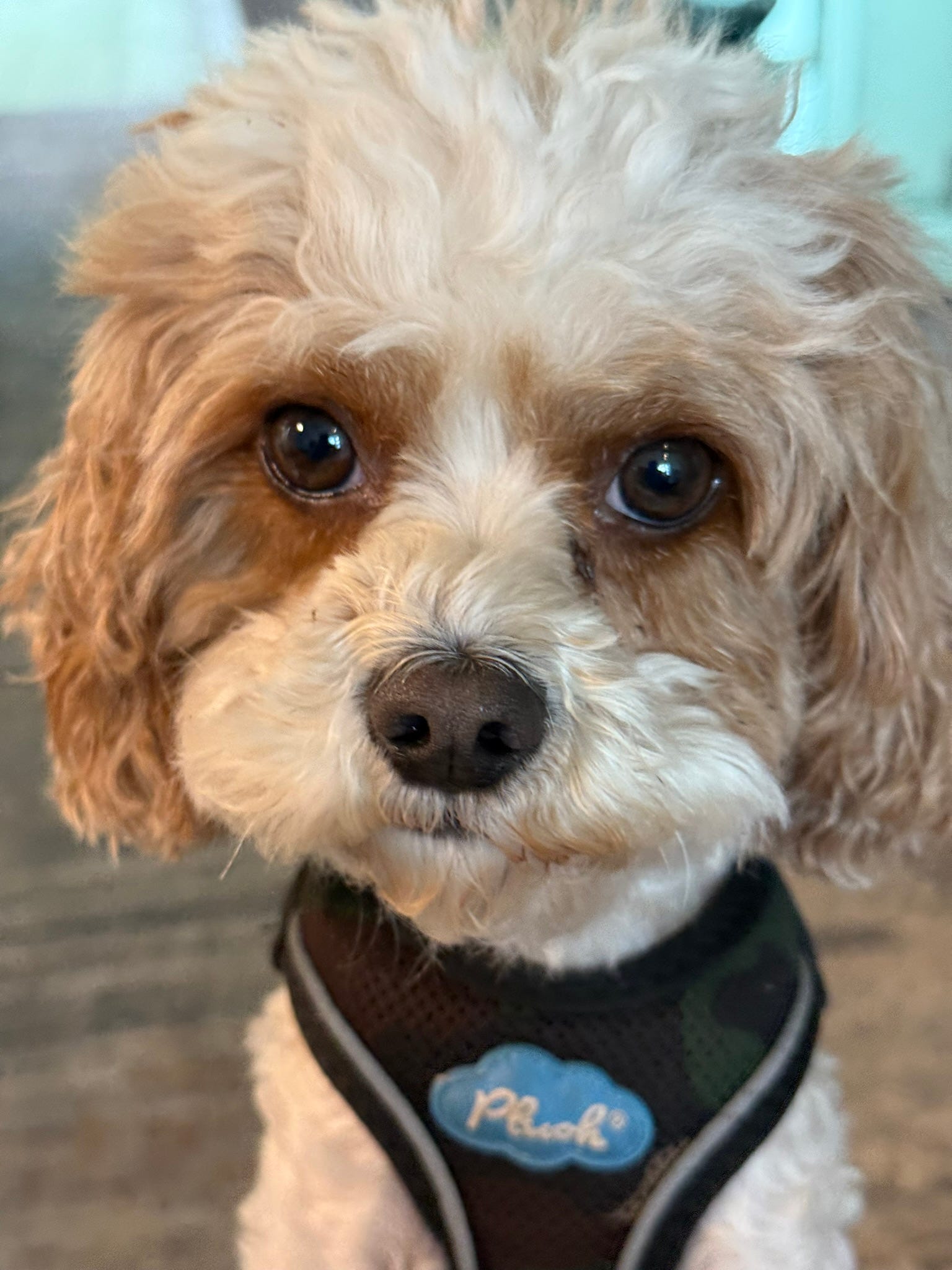
I had been hoping to write about something a little less depressing than Donald Trump. Instead, I find myself writing about my own death. So, in that sense, this is an upbeat pivot.
My friend Ned has long given more thought to his posthumous logistics than most people give to retirement, kitchen remodeling, or their second marriage—with avid attention, a deep bench of specialized knowledge, and the unmistakable sense that he means to be better prepared for it than the rest of us. Ned does not merely acknowledge mortality. He workshops it. He curates it. At one point, he had arranged for a Catholic priest here in St. Petersburg to conduct a service, while also planning for his body to be flown north for burial near where he grew up in Rockville, Maryland. But then his brother, who lives in Montana, balked at the idea of making multiple trips—one for a service and another for a burial. Apparently the family is not enthusiastic about graveside services, at least not in separate installments. So Ned, ever practical, solved the problem the way only Ned could—by acquiring a second burial plot in St. Petersburg to spare his family the inconvenience. One-stop shopping, I guess. He tried to sell me the other one, on the theory that an ex-president of the University of Maryland student body ought to be buried in Maryland. I have to admit I am probably the only person in St. Petersburg, Florida, with a Maryland state flag though I never thought of it as an accoutrement for a coffin.
I normally avoid the subject of death. I have a will, which already feels to me like a heroic amount of adult responsibility. Ned has often reminded me that I ought to think more seriously about the burden my death might place on friends and family. After uttering expletives and telling him to mind his own damn business, I usually respond that I have tried not to be much of a burden in life, so perhaps it would be nice to give friends and family a modest task at the end. Kidding. Sort of.
The truth is that, for the most part, I do not care very much what happens to me after I die. Let the maid find me. That may sound glib, but it is honestly how I feel. I will be dead. But there is one thing I do care about, and care about very much. I live alone with my dog, Alfie, and if I were suddenly to drop dead at home, I do not want him left alone in what could quickly become a frightening and awful situation—no food, no company, no explanation, and no one coming through the door when they are supposed to.
I do not worry about Alfie in the larger sense. He is, quite frankly, better known in the neighborhood than I am and far more popular. He is a small local celebrity, beloved out of all proportion to his size, and I have no doubt that if anything happened to me, he would have a line of prospective adopters around the block before my obituary was even proofread. He would land on his paws. In fact, he might upgrade. Still, there is an immediate problem to solve between the moment I keel over and the moment the neighborhood rescue operation begins. That is the part that worries me.
And it turns out there is, in fact, an app for that. Or at least three. Since this is apparently where my life has led me, I did a little shopping in the cheerful category of What Happens If I Die and the Dog Needs Lunch? I do not plan on getting into app reviews for a living, but I thought I might as well in this case, as it could be helpful to my Substack readers. For the posthumous version of Alfie and Me, three options stood out to me, though I recognize there are others.
Snug seems to be the best known and probably the most polished. Its basic model is a daily check-in. You choose a time, tap the green button to confirm you are fine, and if you miss your check-in, your emergency contacts get alerted. Its free plan texts your contacts after a missed check-in, while its paid Dispatch Plan calls you first, then your contacts, and only if no one can be reached does it request a wellness check from local EMS—which feels like the right order of operations. It pitches itself explicitly to people who live alone and want reassurance that someone will know quickly if something is wrong. That struck me as practical, humane, and refreshingly free of melodrama.
Then there is Are You Still Alive?—now rebranded for global markets as Demumu, though it began life in China as Sileme, which is Mandarin for “Are You Dead Yet?” The name was a deliberate parody of Ele.me, China’s ubiquitous food delivery app, whose name means “Are You Hungry?”—flipping a mundane daily question into a life-or-death check. The concept is bracingly simple: tap a large green button each day to confirm you are okay, and if you miss enough check-ins, your chosen emergency contact gets alerted. I suppose that there is something almost admirable about an app that knows exactly what ghastly question it was designed to answer and sees no point in euphemism.
These apps are sometimes collectively called “dead man’s switch apps,” but there is also a standalone Dead Man’s Switch—or DMS—which has a different vibe altogether. It is less “daily welfare check” and more “if I disappear, release the documents.” The basic concept is that you write emails in advance, designate recipients, and keep checking back in; if you stop responding to reminders, the messages go out. The most famous real-world version of this was fugitive whistleblower Edward Snowden, who reportedly distributed encrypted copies of his documents to trusted people and set up a switch to email the encryption key if anything happened to him. Using it feels a little like volunteering for the Patriot Act. If my main concern is getting someone over to the house to make sure Alfie is fed and walked, posthumous email dispatch is probably not the most elegant solution.
There are clearly others entering this strange little lane of the app economy—some with names even blunter than these, some with slightly different check-in intervals and alert methods. So I am not claiming this is a comprehensive market survey. But the category itself is now real: quiet little systems for people who live alone and would prefer not to have their pet’s health and welfare placed at risk.
We live in an age of artificial intelligence, autonomous vehicles, and billionaires promising immortality through data centers, and one of the most useful modern inventions, to me at least, may be the humble check-in app for people who live alone and would prefer not to leave the dog in a jam. It is not really about fear of death. It is about love, responsibility, and the mundane practicalities that love creates. Love rarely announces itself in grand, cinematic gestures. More often it shows up as a reminder on your phone asking whether you are still alive.
My friend Ned, naturally, would approve of all this, though he would probably suggest a backup system, a printed binder, two emergency contacts, and a laminated instruction sheet attached to the refrigerator. He may not be wrong. But I admit I find something reassuring in the smaller version of preparedness—not the burial plots, not the transport arrangements, not the full production of death as an event, but the simple idea that if I vanish unexpectedly, someone will know to come check on Alfie.
That, in the end, is the only part of my death that feels urgent to me. Not where I am buried. Not whether anyone says anything eloquent. Not whether my remains wind up in Florida, Maryland, or wherever. If you share your home with a creature who depends on you completely, then you owe him or her a plan.
Others can worry about a grave plot for me, though I may have a few more years to adjust. Rumor has it that Ned may be in the market for a mausoleum, so more plots may soon be on the market here in St. Petersburg. But for now, the dog, at least, deserves a system. And I will try to make the next installment of the Alfie and Me series about a cheerier subject. 🐶
Howard: you may not have intended for your subscribers to read this with a small smile. However, I do have one. And I suspect it will stay there for a while. Good luck in the afterlife.
A woman from a nearby community committed suicide leaving 4 dogs in the house. They were discovered 3 or 4 days later. She provided in her will that if they were not adopted in a week they were to be euthanized. She left money for that. Luckily we have a strong animal rescue community here and things worked out for the dogs.